Why You Need a Tampa Divorce Attorney
The Benefits of Legal Representation in Florida Divorce Proceedings
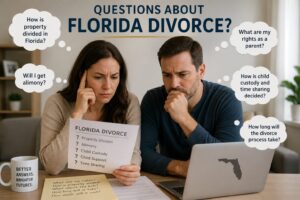
Florida Divorce Questions www.deboradiazlaw.com
| Key Takeaways
• Florida divorce law (Chapter 61, Fla. Stat.) is extensive — an attorney protects your rights at every stage. • Equitable distribution, alimony, and parenting plans each carry complex legal standards that affect your long-term finances and family. • Most Florida divorces settle through negotiation or mediation — skilled advocacy matters even without a trial. • Errors in financial disclosures, settlement agreements, or court filings can create lasting legal and financial problems. • Attorney Debora A. Diaz provides experienced, personalized representation for Tampa-area clients. |
Divorce is one of the most consequential legal events a person can experience, yet many people attempt to navigate the process without an attorney — especially when both spouses appear to be on amicable terms. While Florida law permits self-representation (“pro se”) in divorce proceedings, doing so carries significant risks that are frequently underestimated. Florida’s dissolution of marriage process is governed by Chapter 61 of the Florida Statutes, covering everything from property division to child custody. Below, Attorney Diaz explains the critical advantages of securing experienced legal counsel.
What Does a Florida Divorce Attorney Actually Do?
A skilled divorce attorney brings deep knowledge of the statutes and case law that govern your specific situation — and manages the procedural demands that can derail a self-represented case.
Florida is a no-fault divorce state: a marriage may be dissolved simply upon a showing that it is “irretrievably broken” (§61.052, Fla. Stat.). But no-fault does not mean consequence-free. The legal obligations surrounding property, support, and parenting remain fully in force.
Your attorney will navigate critical areas including:
- Equitable distribution of marital assets and liabilities (§61.075)
- Alimony determinations (§61.08)
- Parenting plans and time-sharing schedules (§61.29)
- Mandatory financial disclosures under Florida Family Law Rule of Procedure 12.285
- Filing deadlines, proper service of process, and court submissions
Missing a filing deadline or submitting an incomplete financial disclosure can jeopardize your case or cause costly delays — mistakes that are far more common in pro se proceedings.
How Is Marital Property Divided in a Florida Divorce?
Florida follows the doctrine of equitable distribution (§61.075, Fla. Stat.), meaning the court divides marital assets and liabilities fairly — though not always equally — based on statutory factors.
Those factors include:
- Each spouse’s contribution to the marriage (financial and non-financial)
- The economic circumstances of each party
- The duration of the marriage
- Whether either spouse intentionally wasted or dissipated marital assets
Complex assets require specialized legal and financial analysis. Common examples include:
- Defined benefit pension plans and retirement accounts (often requiring a Qualified Domestic Relations Order — QDRO)
- Business valuation and ownership interests
- Stock options and deferred compensation
- Real property held in various ownership structures
When a spouse is suspected of concealing or dissipating assets — which is more common than many clients expect — an attorney can pursue formal discovery, including interrogatories, depositions, and subpoenas, to uncover the full picture and ensure you receive a fair settlement.
How Are Child Custody and Time-Sharing Determined in Florida?
When minor children are involved, the stakes are even higher. Florida courts apply the best interests of the child standard in all matters relating to parental responsibility and time-sharing (§61.13, Fla. Stat.).
The court evaluates a detailed list of factors when establishing a parenting plan, including:
- Each parent’s demonstrated capacity to meet the child’s developmental needs
- The geographic viability of a shared parenting arrangement
- The child’s established routine and school record
- Any history of domestic violence or substance abuse
- The mental and physical health of all parties
Florida law strongly favors both parents’ involvement in a child’s life (§61.13(3)), but achieving an arrangement that genuinely protects your parental rights requires careful legal advocacy.
Long-term financial obligations for children must also be properly addressed, including:
- Child support calculated under the Florida Child Support Guidelines (§61.30, Fla. Stat.)
- Health insurance and uncovered medical expenses
- Educational costs and extracurricular activities
- Life insurance designations to secure support obligations
Do Most Florida Divorces Go to Trial?
No. The vast majority of Florida divorces are resolved through negotiated settlement rather than trial. However, reaching a settlement that truly protects your interests requires skilled negotiation — an area in which most people lack formal training and experience.
An attorney advocates for you throughout:
- Direct negotiations with opposing counsel
- Collaborative divorce proceedings
- Court-ordered mediation (required in most Florida counties prior to trial under Fla. Fam. L. R. P. 12.740)
Your attorney also manages the significant procedural demands of your case, including:
- Detailed financial affidavits (Form 12.902) and mandatory disclosures
- Proper drafting of the Marital Settlement Agreement
- Preparation of the Final Judgment of Dissolution of Marriage
Errors in these documents can have lasting legal and financial consequences — including unenforceable provisions, tax complications, or the need for costly post-judgment modification proceedings under §61.14, Fla. Stat.
Frequently Asked Questions
Can I get a divorce in Florida without an attorney?
Yes. Florida law permits self-representation (pro se). However, errors in financial disclosures, parenting plans, or settlement agreements can create serious long-term problems. An attorney ensures your rights and your children’s interests are properly protected.
How long does a Florida divorce take?
An uncontested divorce with no minor children can be finalized in as little as 20 days after filing. Contested divorces involving complex assets or custody disputes often take several months to over a year. A skilled attorney can help move the process forward efficiently.
What is the difference between contested and uncontested divorce in Florida?
An uncontested divorce means both spouses agree on all issues — property, support, and parenting. A contested divorce means one or more issues remain unresolved and require negotiation, mediation, or a court ruling. Even uncontested divorces benefit from attorney review to ensure the agreement is legally sound and enforceable.
Does Florida require separation before divorce?
No. Florida does not require a period of separation before filing for divorce. A spouse need only establish that the marriage is “irretrievably broken” (§61.052, Fla. Stat.).
How is alimony determined in Florida?
Under §61.08, Fla. Stat., the court considers the standard of living established during the marriage, each spouse’s financial resources and earning capacity, the duration of the marriage, and each party’s contribution to the marriage. Florida law recognizes several types of alimony, including bridge-the-gap, rehabilitative, durational, and permanent alimony.
What happens to the family home in a Florida divorce?
The marital home is typically a marital asset subject to equitable distribution. Options include one spouse buying out the other’s interest, a deferred sale (common when minor children are involved), or an outright sale with proceeds divided. Homestead protections under Florida law add additional complexity and are an important consideration.
Contact Our Office Today
Whether your divorce is straightforward or highly contested, having an experienced attorney in your corner makes a meaningful difference. Debora A. Diaz is well-versed in all aspects of Florida divorce law and is committed to protecting your rights, your financial future, and your children’s well-being. Contact our office today to schedule a confidential consultation.
Call Debora A. Diaz, Esquire at 727-846-1802 to schedule a consultation, or use the scheduling link. Consultations are available by phone or video for convenience.
Debora A. Diaz practices exclusively family law in Florida and is a Florida Supreme Court Certified Family Mediator.
The information contained in this blog post is for general informational purposes only and does not constitute legal advice. Reading this post does not create an attorney-client relationship. Please consult a licensed Florida family law attorney regarding your specific situation.